Car Computer Diagnostics in Riyadh: Live Sensor Telemetry & Trouble Code Analysis
Advanced automotive computer diagnostics and electronic troubleshooting in Riyadh. Reading and analyzing Diagnostic Trouble Codes (DTCs), reviewing Freeze Frame telemetry, graphing live sensor data, and identifying the true root causes of Check Engine, ABS, and SRS Airbag warning lights without arbitrary sensor replacements.
🎁 Special opening discount on maintenance, suspension repairs and engine overhauls, plus a complimentary vehicle inspection.
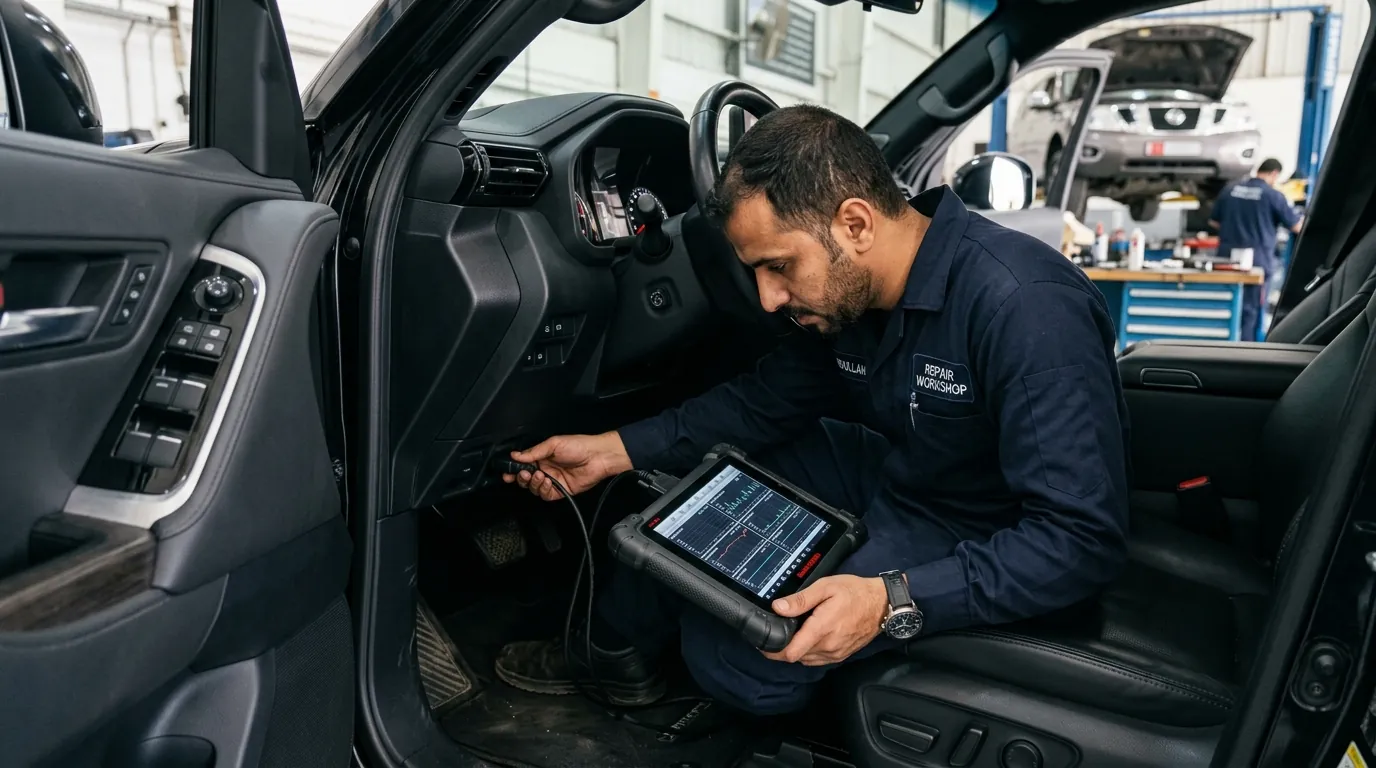
Situations Requiring In-Depth Computer Diagnostics
Computer diagnostics is not just pulling codes; it is an engineering analysis of how your vehicle's electronic control modules behave under load:
Active or Flashing Check Engine Light (CEL)
A solid light indicates a recorded fault code in the engine control unit (ECU); a flashing light indicates severe misfiring risking catalytic converter destruction.
Intermittent Engine Hesitation or Misfires Under Load
Tracking live misfire counters and fuel trim adjustments during a test drive isolates the exact cylinder suffering from ignition or fuel metering failure.
Safety System Warnings (ABS, Traction Control, Airbag)
Illuminated stability or airbag indicators require accessing specialized chassis and body modules to test wheel speed sensors and clockspring integrity.
Excessive Fuel Consumption & Unburnt Gasoline Odor
Analyzing live oxygen (O2) and mass airflow (MAF) sensor data graphs reveals whether the engine is running excessively rich due to sensor drift.
Transmission Limp-Home Mode & Delayed Shifts
When the transmission locks into a single gear for safety, reading transmission control module (TCM) pressure sensor data pinpoints solenoid or clutch issues.
Why a Diagnostic Trouble Code Does Not Always Mean a Bad Sensor
At Faris Al Arab Center 2 in Riyadh, we educate our customers on a vital engineering truth: a Diagnostic Trouble Code (DTC) identifies an out-of-range signal, but it does not prove the sensor itself is defective. For example, an O2 sensor or catalytic efficiency code (P0420) can easily be triggered by an exhaust leak or vacuum leak rather than a failed sensor.
We apply a dual-validation protocol: 1. Extract active and pending codes alongside Freeze Frame telemetry (recording vehicle speed, coolant temperature, and engine load at the instant of failure). 2. Graph live sensor data and test circuit reference voltage and ground with a multimeter before recommending any parts replacement.
Electronic Control Modules & Networks We Diagnose
We scan and test all onboard computer modules across the vehicle network:
Engine Control Unit (ECU / PCM)
Transmission Control Module (TCM)
Anti-Lock Braking & Stability Module (ABS / ESP)
Body Control & Restraint Module (BCM & SRS Airbag)
Controller Area Network (CAN-Bus Network)
Real-Time Sensor Waveform Analysis & High-Speed Oscilloscope Diagnostics
Our high-end diagnostic suites feature multi-channel digital oscilloscopes capable of capturing live sensor signal waveforms at microsecond intervals. High-speed waveform graphing is the only definitive method to catch intermittent electronic glitches, dropped communication packets, or erratic sensor output that occurs in milliseconds without setting a persistent trouble code.
For example, when diagnosing crankshaft (CKP) and camshaft (CMP) position sensors, we overlay both digital waveforms to verify exact mechanical timing synchronization and inspect for damaged reluctor wheel teeth. We also graph electronic throttle pedal position (APP) sensor traces to confirm zero signal dropout throughout the entire throttle sweep.
This deep engineering methodology prevents arbitrary sensor swapping, delivering verified root-cause resolution on the very first visit.
- •Analyze Short Term and Long Term Fuel Trim (STFT / LTFT) percentages to isolate vacuum leaks and fuel delivery deficits.
- •Monitor Variable Valve Timing (VVT) solenoid duty cycle and camshaft advance/retard response angles.
- •Test Controller Area Network (CAN-Bus) digital signal integrity and verify 120-ohm terminal resistance.
Anti-Lock Braking (ABS) and Electronic Stability Program (ESP) Diagnostics
Modern active safety networks (ABS, ESP, Traction Control) rely on magnetic wheel speed sensors, steering angle sensors, and lateral acceleration yaw-rate sensors. A failing wheel speed sensor or magnetic tone ring packed with metallic brake dust immediately disables stability controls.
We log individual wheel speed telemetry during road testing to isolate the malfunctioning wheel hub sensor, testing ABS hydraulic pump motors and solenoid valves to restore full emergency braking capability.
Basic Code Scanners vs. Comprehensive Live Telemetry Analysis
Generic pocket code readers only display a static code number; they cannot display live sensor telemetry. When a code indicates lean fuel mixture, our engineers analyze Short Term and Long Term Fuel Trims (STFT / LTFT).
If fuel trims are positive at idle (+20%) but return to normal (+2%) under highway load, this confirms a mechanical vacuum leak around the intake manifold gasket. Replacing the MAF sensor in that scenario would be a complete waste of money. Our live telemetry analysis saves you from unnecessary parts expenditures.
- •Analyze fuel trim percentages to accurately differentiate vacuum leaks from sensor failures.
- •Graph O2 sensor switching frequency to test catalytic converter efficiency.
- •Review misfire counter graphs to identify cylinder-specific ignition degradation.
Drive Cycle Verification Post-Repair
We do not simply clear codes and hand back keys. After completing a mechanical or electrical repair, our technicians perform a drive cycle to allow vehicle onboard monitors (Catalyst, Evap, O2, Misfire) to reach Ready status.
This rigorous verification ensures that the underlying fault has been permanently resolved and that the warning light will not reappear down the road.
How We Execute Your Vehicle Service Step-by-Step
OBD2 Connection & All-Module Scan
Auto-identifying vehicle VIN, powertrain model, and scanning all onboard modules.
DTC & Freeze Frame Analysis
Documenting trouble codes and the exact operating conditions when faults triggered.
Live Data Graphing & Circuit Validation
Evaluating real-time sensor waveforms and verifying physical circuit reference voltage.
Findings Review & Repair Recommendation
Presenting a clear explanation of root causes and the specific repairs required.
Post-Repair Clearing & Drive Cycle Validation
Confirming monitor readiness, verifying no pending codes, and final sign-off.
Complementary Services You May Need
Car and ECU Programming
Throttle relearn, sensor calibration, and module adaptation.
Auto Electrical Repair in Riyadh
Wiring harness tracing, alternator testing, and battery drain repair.
Auto Mechanic in Riyadh
Mechanical intake leak repair and fuel pump replacement.
Engine Overhaul in Riyadh
Cylinder compression testing and mechanical engine rebuilding.
Convenient Location & Easy Navigation in Riyadh
Faris Al Arab 2 is strategically located in Riyadh, providing swift access from major ring roads and neighborhoods across the capital:
Riyadh, Kingdom of Saudi Arabia (Pinned on Google Maps)
GPS Coordinates: 24.637548, 46.742252
Branch 2 on Google Maps
Click below to load the interactive map and review the fastest driving directions
Common Questions About Car Computer Diagnostics in Riyadh
Have a specific question about your vehicle not answered here?
Ask Our Engineer on WhatsAppNeed Technical Advice or a Vehicle Inspection in Riyadh?
Connect immediately with our service engineers at Faris Al Arab via WhatsApp or phone. We are ready to assist you with technical guidance and welcome your vehicle for inspection.